
The Rise of ‘Artisanal Vintage’ in 2026

As we move deeper into 2026, the fashion world is finally hitting a breaking point with the "new-ness" of the fast-fashion cycle. We’ve lived through decades of disposable trends, but there is a quiet, powerful revolution happening in the ateliers of those who value history. I call it the rise of Artisanal Vintage, and for me, at SP Couture, this isn't just a trend, it’s the soul of everything I create.
For years, I’ve felt that every piece of clothing has a story. It’s written in the grain of a 1950s French silk, the weight of a Victorian bodice, or the particular fade of a mid-century Italian velvet. When I source these vintage fashions from Europe, I’m not just buying fabric; I’m becoming the steward of a narrative. But the story shouldn't end when the original owner stops wearing it. That’s where the "Artisanal" element comes in. By upcycling these treasures and layering them with the rigorous techniques of haute couture, we aren't just recycling, we are elevating the story to its next, most glorious chapter.
The New Generation: Craving Substance over Speed
What I find most exciting about 2026 is the shift in the "new generation" of fashion lovers. We are seeing a demographic that is weary of the "see-now, buy-now, toss-tomorrow" culture. They are craving traditional pieces that buck the trend of fast fashion. They want to know who made their clothes, where the materials came from, and most importantly, they want something that no one else on the planet owns.
Artisanal Vintage meets this need perfectly. It bridges the gap between sustainability and high-end luxury. When you take a vintage garment, already rich with European history, and apply hand-wrought couture techniques, you create a piece of wearable art that is inherently ethical. You aren't tapping into a supply chain; you are tapping into a legacy.
The Magic of the Tambour Hook
At the heart of my process is a dedication to techniques that many modern brands have deemed "too slow." One of my greatest loves is Tambour embroidery, also known as Luneville embroidery.

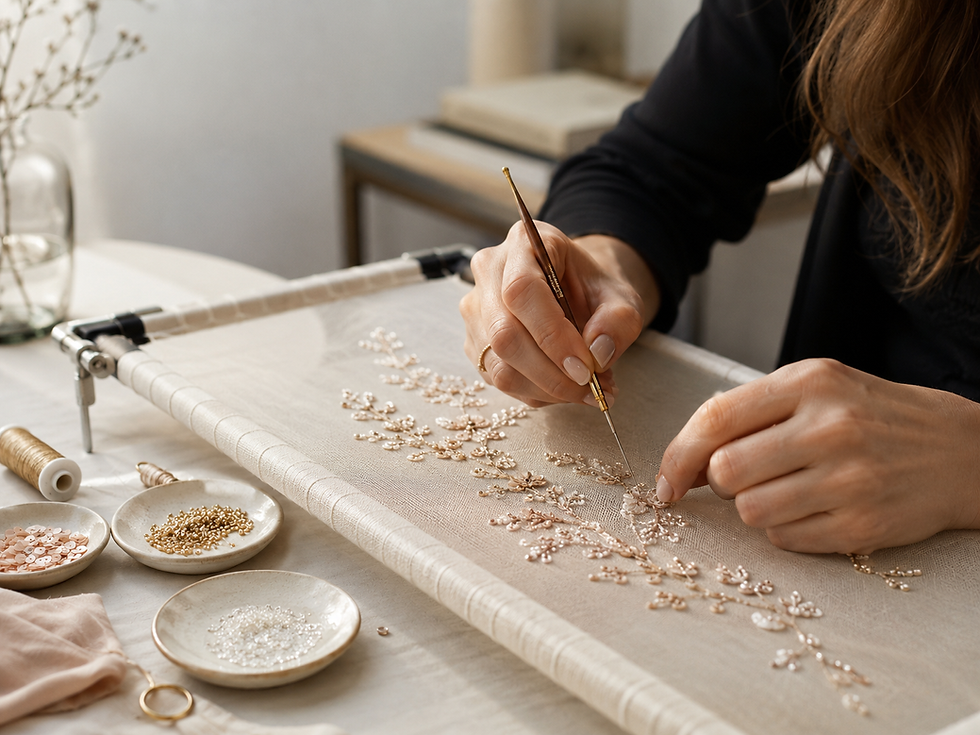
If you aren't familiar with this French couture staple, it is a method of embroidery that uses a small, sharp hook rather than a traditional needle. The fabric is stretched tight on a large frame, and the artisan works from the underside of the fabric. It is a rhythmic, almost meditative dance. Using the tambour hook allows me to create intricate chain stitches and, more importantly, to apply beads and sequins with a precision and speed that a needle simply cannot match.
However, "speed" in the world of Tambour is relative. A single panel for an SP Couture jacket might take forty or fifty hours of focused hand-work. When I apply these shimmering glass beads or vintage sequins to a 1940s crepe I found in a market in Paris, the transformation is breathtaking. The weight of the beads gives the vintage fabric a new drape, a new life, and a structural integrity it hasn't had in decades. This is the "haute" in haute couture, the high art of the hand.
Why European Vintage?
People often ask why I specifically seek out vintage fashions from Europe. It comes down to the foundation. European garment construction from the early-to-mid 20th century was built to last. The seam allowances were generous, the fabrics were often woven on looms that no longer exist, and the silhouettes were designed with a sophisticated understanding of the human form.

By starting with a base of high-quality European vintage, I am starting with a "soul" that is already refined. Whether it’s a structured wool coat from London or a delicate lace blouse from Brussels, these pieces provide a canvas that respects the couture techniques I add. When I combine a vintage French silhouette with the intricate, sparkling textures of Tambour embroidery, the result is a dialogue between the past and the present.
Upcycling as an Act of Preservation
In 2026, upcycling has moved past the "DIY" aesthetic and into the realm of true luxury. I believe that adding elements of haute couture to a vintage piece is an act of preservation. We are saving these garments from the landfill or from sitting forgotten in a trunk, and we are giving them a reason to be celebrated again.
Every bead I set and every stitch I pull with my tambour hook is a promise to that garment: Your story isn't over. We are adding a new verse, one of resilience, beauty, and uncompromising craft.
The rise of Artisanal Vintage is a signal that we are ready to slow down. We are ready to invest in pieces that have a heartbeat. At SP Couture, I will continue to hunt for those hidden European gems and spend the long, quiet hours at my embroidery frame, ensuring that the clothes we wear in the future are just as storied as the ones from our past.


Comments